
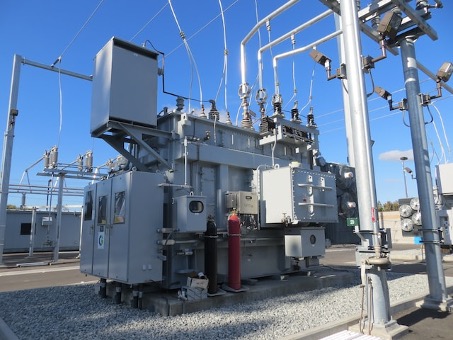
Transformer Parameters and Equivalent Circuit (Short Circuit Transformer)
Short circuit voltage is one of the most important parameters of a transformer. It is indicated as %Uk (or %Z) on the transformer’s technical data sheet.
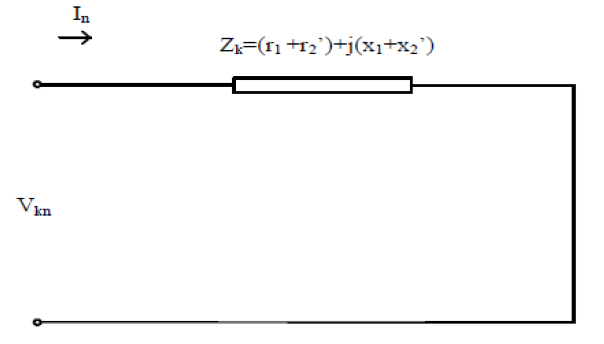
Short circuit voltage (%Uk) is the voltage that must be applied to the primary winding (with the secondary winding short-circuited) to produce the rated nominal current in the primary. This value directly determines the maximum short-circuit current that will flow in case of a fault on the secondary side and is critical for protection device selection.
For distribution transformers:
- Up to 400 kVA → typically %Uk = 4.5%
- Up to 5 MVA → usually between 6% and 8%
- Larger power transformers have higher %Uk values.
Transformer Losses
Transformer efficiency is mainly affected by two types of losses:
- No-load losses (Iron / Core losses): Caused by hysteresis and eddy currents in the magnetic core.
- Load losses (Copper losses): Caused by the resistance of the windings under load.
Reducing these losses is key to achieving high transformer efficiency.
Short Circuit Transformer Current Calculation
The short-circuit current (Ik) of a transformer can be calculated as:
Ik = In / (%Uk / 100)
Where In is the rated nominal current of the transformer.
This calculation must be performed separately for both primary and secondary sides because voltage and current ratings differ.
Transformer Equivalent Circuit
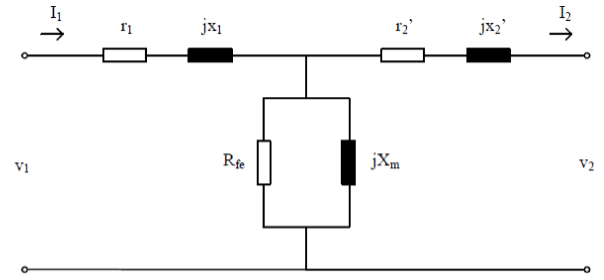
Because the primary and secondary windings are magnetically coupled but electrically isolated, we use an equivalent circuit referred to one side (usually the primary).
The most common model is the T-type equivalent circuit referred to the primary side. It includes:
- r1, x1 → Primary winding resistance and leakage reactance
- r’2, x’2 → Secondary winding resistance and leakage reactance referred to primary
- Rfe → Core loss resistance
- Xm → Magnetizing reactance
These parameters are determined through short circuit test and open circuit (no-load) test.
Transformer Equivalent Circuit
Short Circuit Test (Short Circuit Transformer Test)
In the short circuit test, the secondary winding is short-circuited and a reduced voltage is applied to the primary until rated current flows. This test gives the copper losses and the total impedance of the transformer.
Open Circuit (No-Load) Test
In the open circuit test, the secondary is left open and rated voltage is applied to the primary. This test determines the core losses (iron losses), magnetizing current, and the values of Rfe and Xm.
Apparent, Active, and Reactive Power
- Apparent Power (S) = V × I
- Active Power (P) = S × cosφ
- Reactive Power (Q) = S × sinφ
Understanding transformer parameters and the equivalent circuit is essential for proper transformer selection, protection coordination, and system short-circuit analysis.
Looking for Transformer for your project?
Looking for detailed technical information on transformer parameters, equivalent circuit, short circuit voltage, and short circuit calculations? We provide expert support for distribution and power transformers tailored to your needs.
For quotations and requests: info@electricistanbul.com
Whatsapp: +90 501 076 69 91